#include <SpecifiedPrimitiveDataType.hpp>
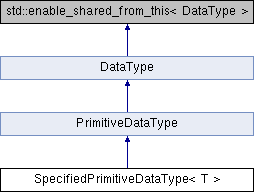
Public Member Functions | |
| SpecifiedPrimitiveDataType () | |
| SpecifiedPrimitiveDataType (const SpecifiedPrimitiveDataType< T > &original)=default | |
| ~SpecifiedPrimitiveDataType ()=default | |
| SpecifiedPrimitiveDataType< T > & | operator= (SpecifiedPrimitiveDataType< T > &rhs)=default |
| bool | validate (DataTypeInator *dataTypeInator=NULL) override |
| Verify that all of the types that are named by this DataType or subordinate DataTypes are resolvable to actual DataTypes in the TypeDictionary. More... | |
| bool | isValid () const override |
| Determine whether this type has already been successfully validated. More... | |
| size_t | getSize () const override |
| void * | createInstance (unsigned int num) const override |
| void | deleteInstance (void *address) const override |
| Delete this instance. More... | |
| void | clearValue (void *address) const |
| Clear the variable at the given address. More... | |
| bool | assignValue (void *address, Value *value) const |
| Value * | getValue (void *address) const |
| Creates a Value object for the variable at the given address. More... | |
| void | printValue (std::ostream &s, void *address) const |
| std::string | getTypeSpecName () const |
| bool | isFloatingPoint () const |
| bool | isSigned () const |
| bool | isVoid () const |
| bool | isFloatingPoint () const |
| Determine whether this is an integer type or floating point type. More... | |
| bool | isFloatingPoint () const |
| Determine whether this is an integer type or floating point type. More... | |
| bool | isSigned () const |
| Determine whether type is signed. More... | |
| bool | isSigned () const |
| Determine whether type is signed. More... | |
| bool | isSigned () const |
| Determine whether type is signed. More... | |
| bool | isSigned () const |
| Determine whether type is signed. More... | |
| bool | isSigned () const |
| Determine whether type is signed. More... | |
| bool | isVoid () const |
| Is the type void? More... | |
| void | printValue (std::ostream &s, void *address) const |
| Print an ascii representation of the value at the given address to the stream. More... | |
| void | printValue (std::ostream &s, void *address) const |
| Print an ascii representation of the value at the given address to the stream. More... | |
| size_t | getSize () const |
| The size (in bytes) of an instance of the DataType. More... | |
| void * | createInstance (unsigned int num) const |
| Create one or more instances of this type. More... | |
| void | deleteInstance (void *address) const |
| Delete this instance. More... | |
| void | clearValue (void *address) const |
| Clear the variable at the given address. More... | |
| bool | assignValue (void *address, Value *value) const |
| Assign a value to the variable at the given address. More... | |
| void | printValue (std::ostream &s, void *address) const |
| Print an ascii representation of the value at the given address to the stream. More... | |
| Value * | getValue (void *address) const |
| Creates a Value object for the variable at the given address. More... | |
| std::string | getTypeSpecName () const |
| Get the Type Spec Name object. More... | |
| std::string | getTypeSpecName () const |
| Get the Type Spec Name object. More... | |
| std::string | getTypeSpecName () const |
| Get the Type Spec Name object. More... | |
| std::string | getTypeSpecName () const |
| Get the Type Spec Name object. More... | |
| std::string | getTypeSpecName () const |
| Get the Type Spec Name object. More... | |
| std::string | getTypeSpecName () const |
| Get the Type Spec Name object. More... | |
| std::string | getTypeSpecName () const |
| Get the Type Spec Name object. More... | |
| std::string | getTypeSpecName () const |
| Get the Type Spec Name object. More... | |
| std::string | getTypeSpecName () const |
| Get the Type Spec Name object. More... | |
| std::string | getTypeSpecName () const |
| Get the Type Spec Name object. More... | |
| std::string | getTypeSpecName () const |
| Get the Type Spec Name object. More... | |
| std::string | getTypeSpecName () const |
| Get the Type Spec Name object. More... | |
| std::string | getTypeSpecName () const |
| Get the Type Spec Name object. More... | |
| std::string | getTypeSpecName () const |
| Get the Type Spec Name object. More... | |
| bool | isFloatingPoint () const |
| Determine whether this is an integer type or floating point type. More... | |
| bool | isFloatingPoint () const |
| Determine whether this is an integer type or floating point type. More... | |
| bool | isSigned () const |
| Determine whether type is signed. More... | |
| bool | isSigned () const |
| Determine whether type is signed. More... | |
| bool | isSigned () const |
| Determine whether type is signed. More... | |
| bool | isSigned () const |
| Determine whether type is signed. More... | |
| bool | isSigned () const |
| Determine whether type is signed. More... | |
| bool | isVoid () const |
| Is the type void? More... | |
| void | printValue (std::ostream &s, void *address) const |
| Print an ascii representation of the value at the given address to the stream. More... | |
| void | printValue (std::ostream &s, void *address) const |
| Print an ascii representation of the value at the given address to the stream. More... | |
| size_t | getSize () const |
| The size (in bytes) of an instance of the DataType. More... | |
| void | deleteInstance (void *address) const |
| Delete this instance. More... | |
| void * | createInstance (unsigned int num) const |
| Create one or more instances of this type. More... | |
| void | clearValue (void *address) const |
| Clear the variable at the given address. More... | |
| bool | assignValue (void *address, Value *value) const |
| Assign a value to the variable at the given address. More... | |
| void | printValue (std::ostream &s, void *address) const |
| Print an ascii representation of the value at the given address to the stream. More... | |
| Value * | getValue (void *address) const |
| Creates a Value object for the variable at the given address. More... | |
 Public Member Functions inherited from PrimitiveDataType Public Member Functions inherited from PrimitiveDataType | |
| PrimitiveDataType () | |
| ~PrimitiveDataType () | |
| bool | accept (DataTypeVisitor *visitor) const override |
| Public Member Functions inherited from DataType | |
| virtual | ~DataType () |
| virtual std::string | makeDeclaration (std::string declarator) const |
| virtual std::string | toString () const |
Constructor & Destructor Documentation
◆ SpecifiedPrimitiveDataType() [1/2]
|
inline |
◆ SpecifiedPrimitiveDataType() [2/2]
|
default |
◆ ~SpecifiedPrimitiveDataType()
|
default |
Member Function Documentation
◆ assignValue() [1/3]
|
inlinevirtual |
Assign a value to the variable at the given address.
- Parameters
-
address Address of the variable. value Value to be assigned to the variable.
Implements PrimitiveDataType.
◆ assignValue() [2/3]
|
virtual |
Assign a value to the variable at the given address.
- Parameters
-
address Address of the variable. value Value to be assigned to the element.
Implements PrimitiveDataType.
◆ assignValue() [3/3]
|
virtual |
Assign a value to the variable at the given address.
- Parameters
-
address Address of the variable. value Value to be assigned to the element.
Implements PrimitiveDataType.
◆ clearValue() [1/3]
|
inlinevirtual |
Clear the variable at the given address.
- Parameters
-
address Address of the variable.
Implements PrimitiveDataType.
◆ clearValue() [2/3]
|
virtual |
Clear the variable at the given address.
- Parameters
-
address Address of the variable.
Implements PrimitiveDataType.
◆ clearValue() [3/3]
|
virtual |
Clear the variable at the given address.
- Parameters
-
address Address of the variable.
Implements PrimitiveDataType.
◆ createInstance() [1/3]
|
virtual |
Create one or more instances of this type.
- Parameters
-
n number to create
- Returns
- void* address of the beginnning of the allocation
Implements DataType.
◆ createInstance() [2/3]
|
virtual |
Create one or more instances of this type.
- Parameters
-
n number to create
- Returns
- void* address of the beginnning of the allocation
Implements DataType.
◆ createInstance() [3/3]
|
inlineoverridevirtual |
- Returns
- an instance of the type that this PrimiitveDataType Class describes.
Implements DataType.
◆ deleteInstance() [1/3]
|
virtual |
Delete this instance.
- Parameters
-
address of instance to delete
- Note
- Is this compatible with the createInstance?
Implements DataType.
◆ deleteInstance() [2/3]
|
virtual |
Delete this instance.
- Parameters
-
address of instance to delete
- Note
- Is this compatible with the createInstance?
Implements DataType.
◆ deleteInstance() [3/3]
|
inlineoverridevirtual |
Delete this instance.
- Parameters
-
address of instance to delete
- Note
- Is this compatible with the createInstance?
Implements DataType.
◆ getSize() [1/3]
|
virtual |
◆ getSize() [2/3]
|
virtual |
◆ getSize() [3/3]
|
inlineoverridevirtual |
◆ getTypeSpecName() [1/15]
|
inlinevirtual |
Get a string representation of this SpecifiedPrimitiveDataType's type-specifier.
Implements DataType.
◆ getTypeSpecName() [2/15]
|
virtual |
◆ getTypeSpecName() [3/15]
|
virtual |
◆ getTypeSpecName() [4/15]
|
virtual |
◆ getTypeSpecName() [5/15]
|
virtual |
◆ getTypeSpecName() [6/15]
|
virtual |
◆ getTypeSpecName() [7/15]
|
virtual |
◆ getTypeSpecName() [8/15]
|
virtual |
◆ getTypeSpecName() [9/15]
|
virtual |
◆ getTypeSpecName() [10/15]
|
virtual |
◆ getTypeSpecName() [11/15]
|
virtual |
◆ getTypeSpecName() [12/15]
|
virtual |
◆ getTypeSpecName() [13/15]
|
virtual |
◆ getTypeSpecName() [14/15]
|
virtual |
◆ getTypeSpecName() [15/15]
|
virtual |
◆ getValue() [1/3]
|
inlinevirtual |
Creates a Value object for the variable at the given address.
- Parameters
-
address Address of the variable.
Implements PrimitiveDataType.
◆ getValue() [2/3]
|
virtual |
Creates a Value object for the variable at the given address.
- Parameters
-
address Address of the variable.
Implements PrimitiveDataType.
◆ getValue() [3/3]
|
virtual |
Creates a Value object for the variable at the given address.
- Parameters
-
address Address of the variable.
Implements PrimitiveDataType.
◆ isFloatingPoint() [1/5]
|
inlinevirtual |
Return true if T is float or double. Otherwise return false.
Implements PrimitiveDataType.
◆ isFloatingPoint() [2/5]
|
virtual |
Determine whether this is an integer type or floating point type.
- Returns
- true this type is float or double
- false otherwise
Implements PrimitiveDataType.
◆ isFloatingPoint() [3/5]
|
virtual |
Determine whether this is an integer type or floating point type.
- Returns
- true this type is float or double
- false otherwise
Implements PrimitiveDataType.
◆ isFloatingPoint() [4/5]
|
virtual |
Determine whether this is an integer type or floating point type.
- Returns
- true this type is float or double
- false otherwise
Implements PrimitiveDataType.
◆ isFloatingPoint() [5/5]
|
virtual |
Determine whether this is an integer type or floating point type.
- Returns
- true this type is float or double
- false otherwise
Implements PrimitiveDataType.
◆ isSigned() [1/11]
|
inlinevirtual |
Return true if T is char, short, int, long, or long long. Otherwise return false.
Implements PrimitiveDataType.
◆ isSigned() [2/11]
|
virtual |
Determine whether type is signed.
- Note
- Do we really need this?
- Returns
- true is signed
- false type has unsigned, uint_* type
Implements PrimitiveDataType.
◆ isSigned() [3/11]
|
virtual |
Determine whether type is signed.
- Note
- Do we really need this?
- Returns
- true is signed
- false type has unsigned, uint_* type
Implements PrimitiveDataType.
◆ isSigned() [4/11]
|
virtual |
Determine whether type is signed.
- Note
- Do we really need this?
- Returns
- true is signed
- false type has unsigned, uint_* type
Implements PrimitiveDataType.
◆ isSigned() [5/11]
|
virtual |
Determine whether type is signed.
- Note
- Do we really need this?
- Returns
- true is signed
- false type has unsigned, uint_* type
Implements PrimitiveDataType.
◆ isSigned() [6/11]
|
virtual |
Determine whether type is signed.
- Note
- Do we really need this?
- Returns
- true is signed
- false type has unsigned, uint_* type
Implements PrimitiveDataType.
◆ isSigned() [7/11]
|
virtual |
Determine whether type is signed.
- Note
- Do we really need this?
- Returns
- true is signed
- false type has unsigned, uint_* type
Implements PrimitiveDataType.
◆ isSigned() [8/11]
|
virtual |
Determine whether type is signed.
- Note
- Do we really need this?
- Returns
- true is signed
- false type has unsigned, uint_* type
Implements PrimitiveDataType.
◆ isSigned() [9/11]
|
virtual |
Determine whether type is signed.
- Note
- Do we really need this?
- Returns
- true is signed
- false type has unsigned, uint_* type
Implements PrimitiveDataType.
◆ isSigned() [10/11]
|
virtual |
Determine whether type is signed.
- Note
- Do we really need this?
- Returns
- true is signed
- false type has unsigned, uint_* type
Implements PrimitiveDataType.
◆ isSigned() [11/11]
|
virtual |
Determine whether type is signed.
- Note
- Do we really need this?
- Returns
- true is signed
- false type has unsigned, uint_* type
Implements PrimitiveDataType.
◆ isValid()
|
inlineoverridevirtual |
Determine whether this type has already been successfully validated.
- Returns
- true if validated, false otherwise
Implements DataType.
◆ isVoid() [1/3]
|
inlinevirtual |
Return true if DataType is void. Otherwise return false.
Implements PrimitiveDataType.
◆ isVoid() [2/3]
|
virtual |
◆ isVoid() [3/3]
|
virtual |
◆ operator=()
|
default |
◆ printValue() [1/7]
|
inlinevirtual |
Print the value of the variable at the given address, to the given stream.
- Parameters
-
s The stream to print to. address Address of the variable.
Implements PrimitiveDataType.
◆ printValue() [2/7]
|
virtual |
Print an ascii representation of the value at the given address to the stream.
Implements PrimitiveDataType.
◆ printValue() [3/7]
|
virtual |
Print an ascii representation of the value at the given address to the stream.
Implements PrimitiveDataType.
◆ printValue() [4/7]
|
virtual |
Print an ascii representation of the value at the given address to the stream.
Implements PrimitiveDataType.
◆ printValue() [5/7]
|
virtual |
Print an ascii representation of the value at the given address to the stream.
Implements PrimitiveDataType.
◆ printValue() [6/7]
|
virtual |
Print an ascii representation of the value at the given address to the stream.
Implements PrimitiveDataType.
◆ printValue() [7/7]
|
virtual |
Print an ascii representation of the value at the given address to the stream.
Implements PrimitiveDataType.
◆ validate()
|
inlineoverridevirtual |
Verify that all of the types that are named by this DataType or subordinate DataTypes are resolvable to actual DataTypes in the TypeDictionary.
- Parameters
-
dataTypeInator - type resolver machine
- Returns
- true if successful, false otherwise
Implements DataType.
The documentation for this class was generated from the following file:
- DataTypes/include/Type/SpecifiedPrimitiveDataType.hpp